Tesla FSD on a road trip: eight trips from Kansas City to the Gulf and back.
Long highway miles are where this car earns its keep. I have taken it on eight road trips out of Kansas City so far, the longest being two weeks down to the Florida Gulf and back this July, and the car did nearly all of the driving. This page is everything I learned, including the strikeout warning it gave me on the way home.
The eight trips
Three runs to Wichita. Three to Destin, one of which stopped overnight in Nashville. Destin to Miami and back. And Kansas City to Tulsa. Wichita is a day, Destin is a couple of days each way with the Gulf in between, and the Miami leg was tacked onto one of the Destin trips.
Every one of them was mostly FSD. Not all of it, and I will get to the parts I drove myself. But the car was doing the work for the large majority of those miles.
The car plans the day before you back out of the driveway
Before I left for Alabama I put the destination in and let the car do the math. It came back with 505.7 miles, a little under nine hours, and three Supercharger stops already picked out for me. It also told me what I would roll into each one with, and what I would have left when I got there. Twelve percent, if you are curious.
That is the part people who do not own one of these never quite believe. The range anxiety everybody warns you about is a planning problem, and the car had it solved before I ever backed out. I did not look up a single charger the whole way down. I just drove to the next pin on the screen. The only thing left for me to decide was where we were going to eat.
To be precise about it, that is the navigation and the trip planner doing the planning, not FSD. But they work together so well you stop noticing the difference.
Charging stops are just rest stops
First stop out of Kansas City was the Buc-ee's outside Springfield. Here is the thing about charging on a road trip that I do not think gets said enough: you were going to stop anyway. You need a bathroom. You want to stand up. You are probably going to buy something you do not need, and at a Buc-ee's you definitely are. The car wants about twenty minutes. Those are the same twenty minutes.
I plugged in, went inside, came back out, and it was ready before I was. People picture themselves stranded somewhere watching a battery crawl up a percent at a time. What actually happens is you take the break you were already going to take and the car quietly fills up while you do it.
Where FSD is at its best
A while back I wrote that I would probably never have a streak, because I take over too often for one to run. I was wrong twice in two weeks. Heading down on the seventh, north of Birmingham in the rain, the screen threw confetti at me: 250 miles without a takeover. Coming home on the nineteenth, up around Cullman, it did the same thing again. Same number, same confetti.
What I took from it is not what I expected. The streak is not a measure of how well I supervise. It is a measure of how much of the trip was interstate. Long highway miles are exactly where this car is at its best, and 250 of them in a row on I-65 is not the same accomplishment as 250 around Kansas City would be. Not even close. I will take it anyway.
Night highway driving belongs in this section too. It handles low light, headlights, lit signs and signals without much drama, and a long stretch of interstate at night with the car doing the work is less tiring than doing it yourself. Dark rural roads with faint paint are where I sit up straighter.
The honest parts
It caught me not supervising. Somewhere in the Missouri bootheel on the way home this came up on the screen: telemetry from your vehicle indicates improper use of Full Self-Driving. Four more of those and it quits working for me. My first reaction was to argue with it. About a mile down the road my second reaction was that it was right. I had been driving since early, I was tired, I had 17% left and a charger I needed to get to, and on the back half of a long day home I was not supervising as well as I do on hour one. Nobody is. I would rather it nag me than not.
At 17%, the car starts making its own decisions. Same morning, same screen. Sentry Mode currently unavailable, Low Power Mode is active. Nobody asked me about any of that. Somewhere south of twenty percent the car shut the security cameras down and put every mile it could scrape together toward the charger I still had to reach. Which is exactly the call I would have made. I made the charger, for the record.
Rain. I drove through some real rain on I-65 in Alabama and it did fine, but I was paying closer attention than usual. Heavy downpour is a different animal from a wet road: water on the lenses, spray off the truck ahead. It will slow up, and sometimes it will ask you to take it. It is a vision system. If you cannot see, it cannot see.
Bugs. A southern interstate in summer puts every bug between here and the Gulf on your car, and the front cameras live behind that same glass. The honest answer is that the car goes blind later than I do. It kept right on driving through bug country, and on the rare occasion it gets uneasy it says so and drives more carefully. But keep the glass clean. The squeegee at the Supercharger is the cheapest maintenance in the whole ownership experience, and I hit it at almost every stop.
Construction. It gets through most work zones, following the shifted lanes and respecting the cones, but it does not want to slow down the way I want it to. I treat a construction zone as a take-the-wheel-soon situation, at home and on the road.
The frunk is the cooler
Nobody buys one of these for the trunk under the hood, and then you take one long trip and it turns into the thing you end up telling people about. I filled it with ice. Not a cooler set down inside it, the frunk itself, ice poured straight in and drinks buried in the middle of it. There is a drain plug in the bottom, so when it melts it just goes away and you rinse it out.
Then physics weighed in. That tub is not insulated. It is a plastic box riding in the nose of a car that has been baking on July asphalt, and loose ice in there melts fast. So in the middle of the trip I fixed it for thirty dollars: three soft-sided cooler bags from Walmart, ten bucks apiece, loaded with ice, zipped shut, set side by side in the frunk. They fit like they were made for it, they kept everything cold clear through the hot part of the day, and when I got home they folded flat on a garage shelf. Insulate the ice, not the car.
What I would tell you before a long drive
- Put the destination in and trust the pins. The car will route you through the chargers with the timing worked out. Do not fight it.
- Plan on supervising harder on hour six than on hour one. The car noticed when I did not. It was right.
- Keep the glass clean at every stop. Everything it knows comes in through the cameras.
- Expect to drive the work zones yourself. And heavy rain, when it asks.
- Standard speed profile. On the last few builds the profiles got stronger across the board. Standard gets me there and does not spook anybody in the passenger seat.
- Insulate the ice, not the car. Three ten-dollar bags. You are welcome.
Using FSD does not cost you meaningful range, if you were wondering. The computer draws a little power, but it is nothing next to actually moving the car down the road. Your range is decided by speed, terrain, weather, and how hard you run the climate.
The notes behind this page
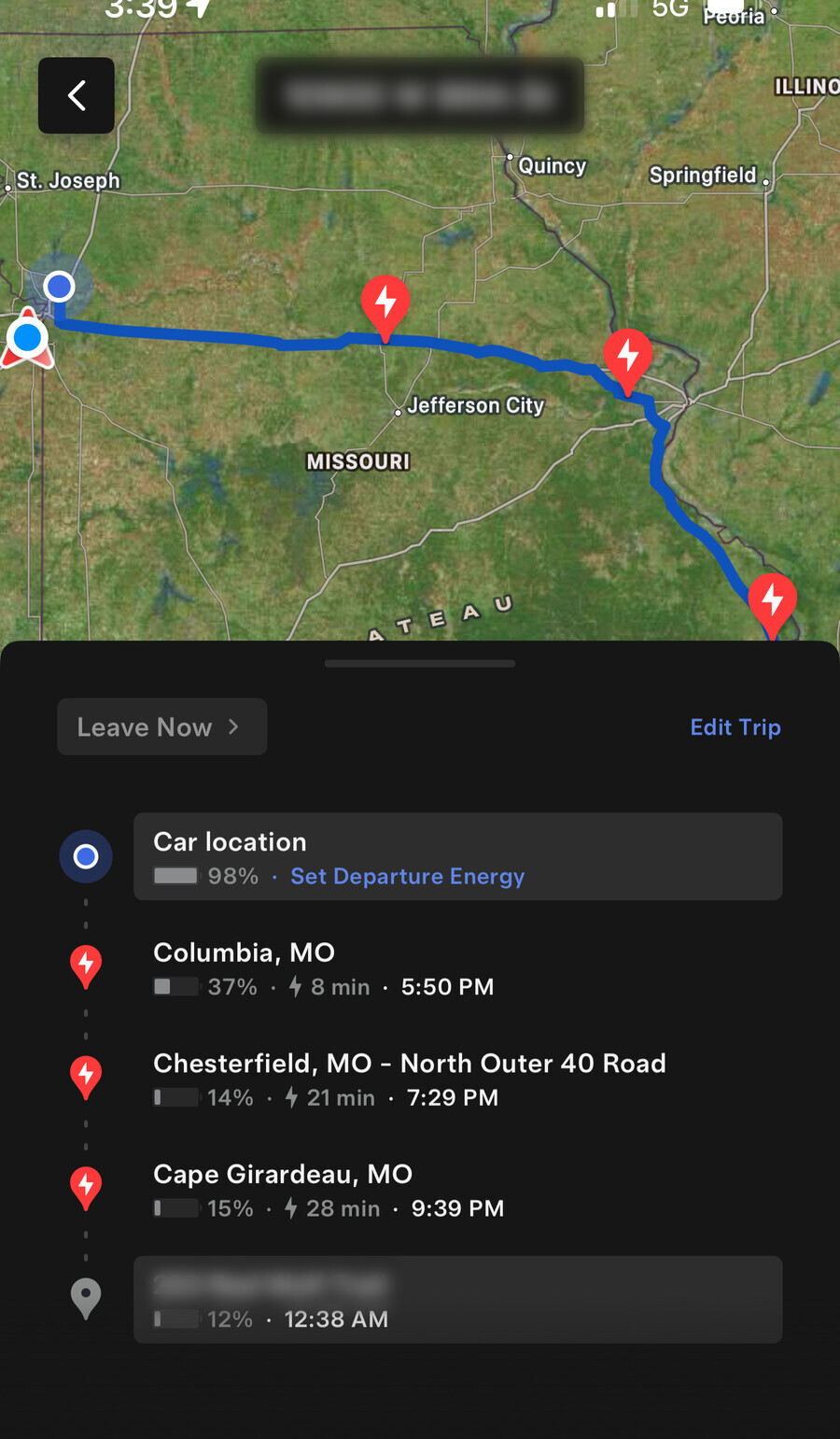
What a 500-mile day looks like before you pull out
Before I left for Alabama I put the destination in and let the car do the math. It came back with 505.7 miles, a little under nine hours, and three Supercharger…
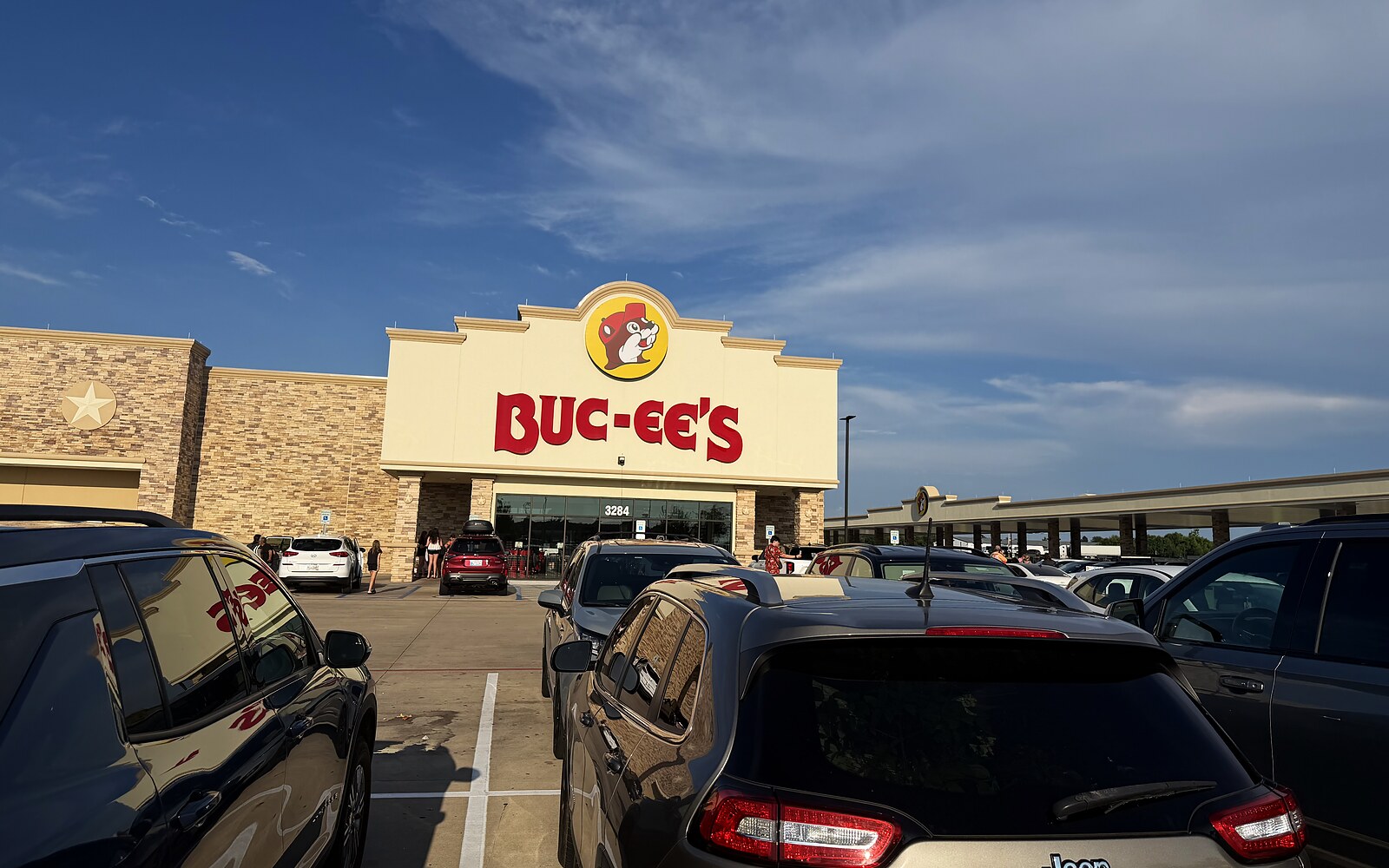
Charging stops are just rest stops now
First stop out of Kansas City was the Buc-ee’s outside Springfield. Here’s the thing about charging on a road trip that I don’t think gets said enough: you were…
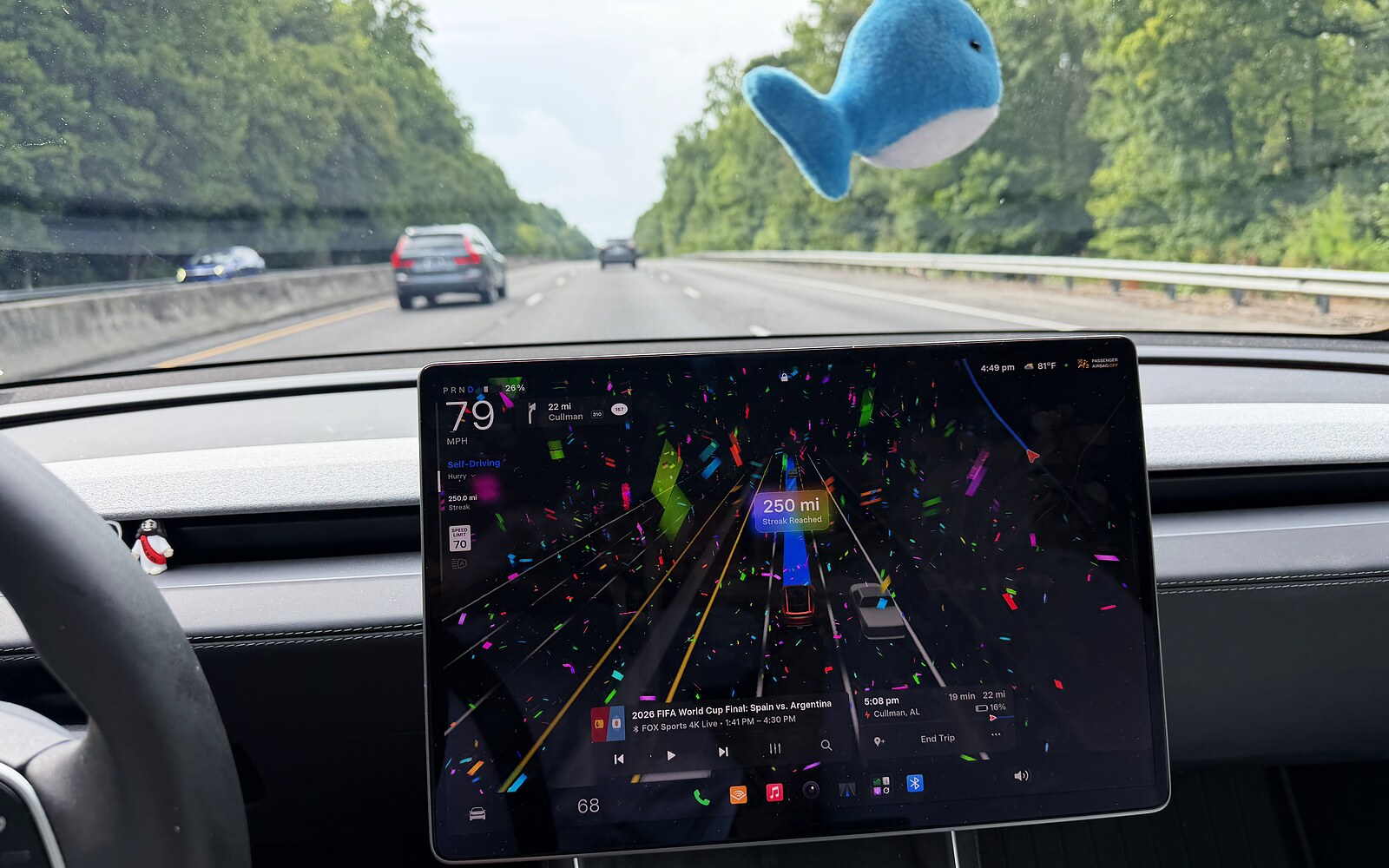
I said I’d never have a streak. The car got two.
A while back I wrote that I’d probably never have a streak, because I take over too often for one to ever run. Turns out I was wrong twice in two weeks. Heading…
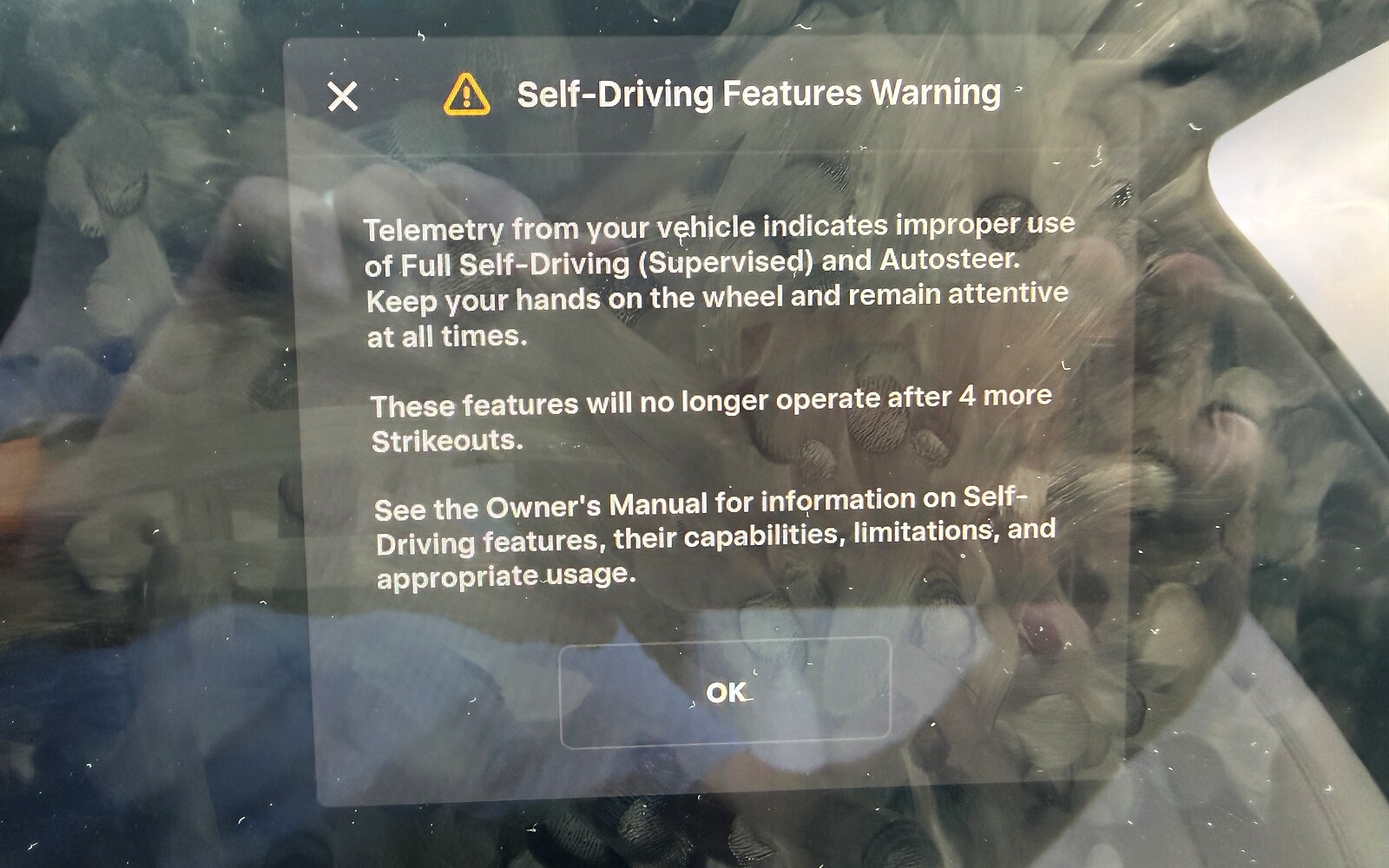
The car gave me a strikeout warning, and it had a point
Somewhere in the Missouri bootheel on the way home this came up on the screen. Telemetry from your vehicle indicates improper use of Full Self-Driving. Four more of…
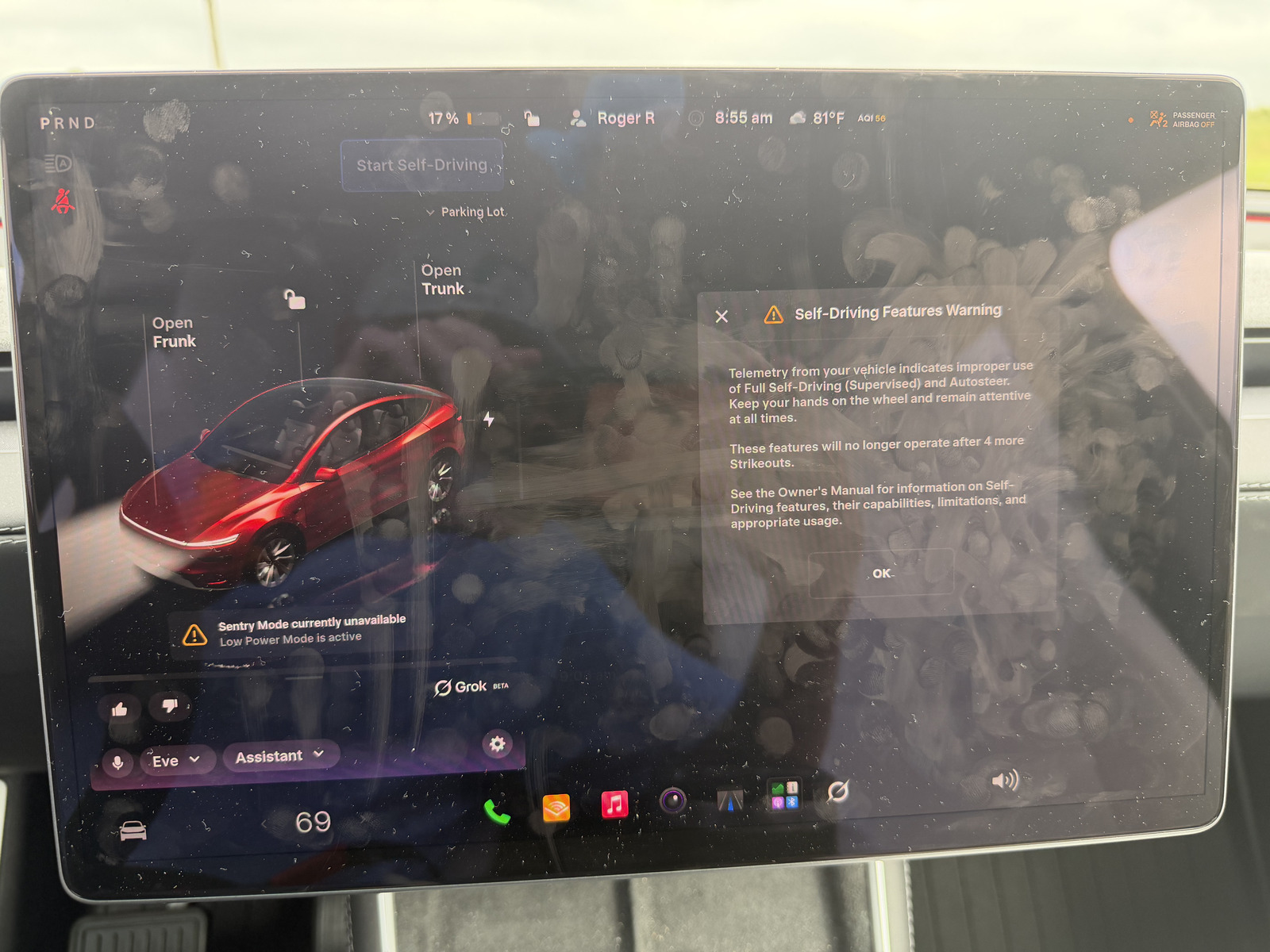
At 17%, the car starts turning things off
Same morning as the strikeout warning, same screen, and here’s the detail I didn’t write about the first time. Look at the top corner: 17%. Now look under the car…
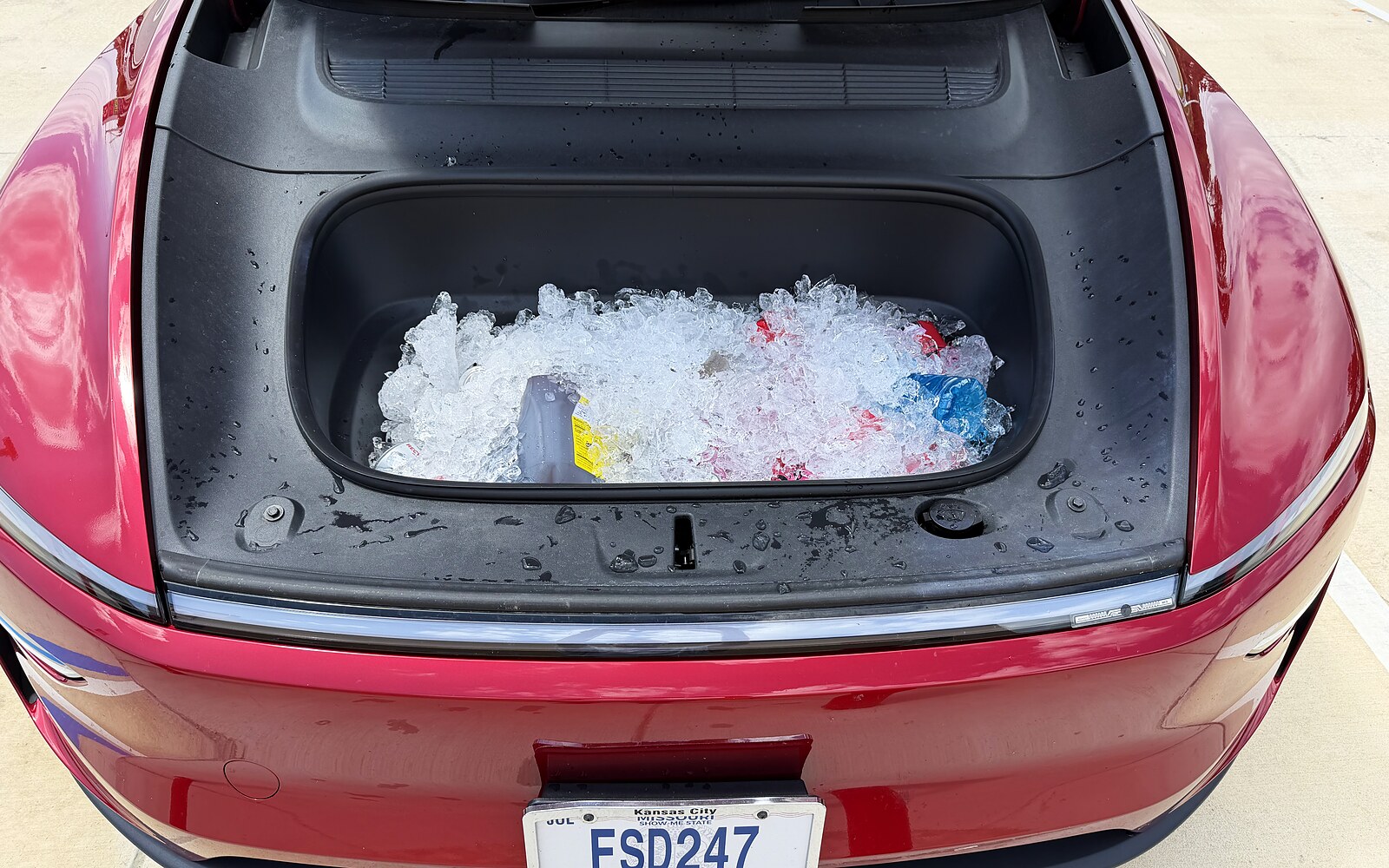
The frunk is the most underrated thing on this car
Nobody buys one of these for the trunk under the hood, and then you take one long trip and it turns into the thing you end up telling people about. I filled it with…
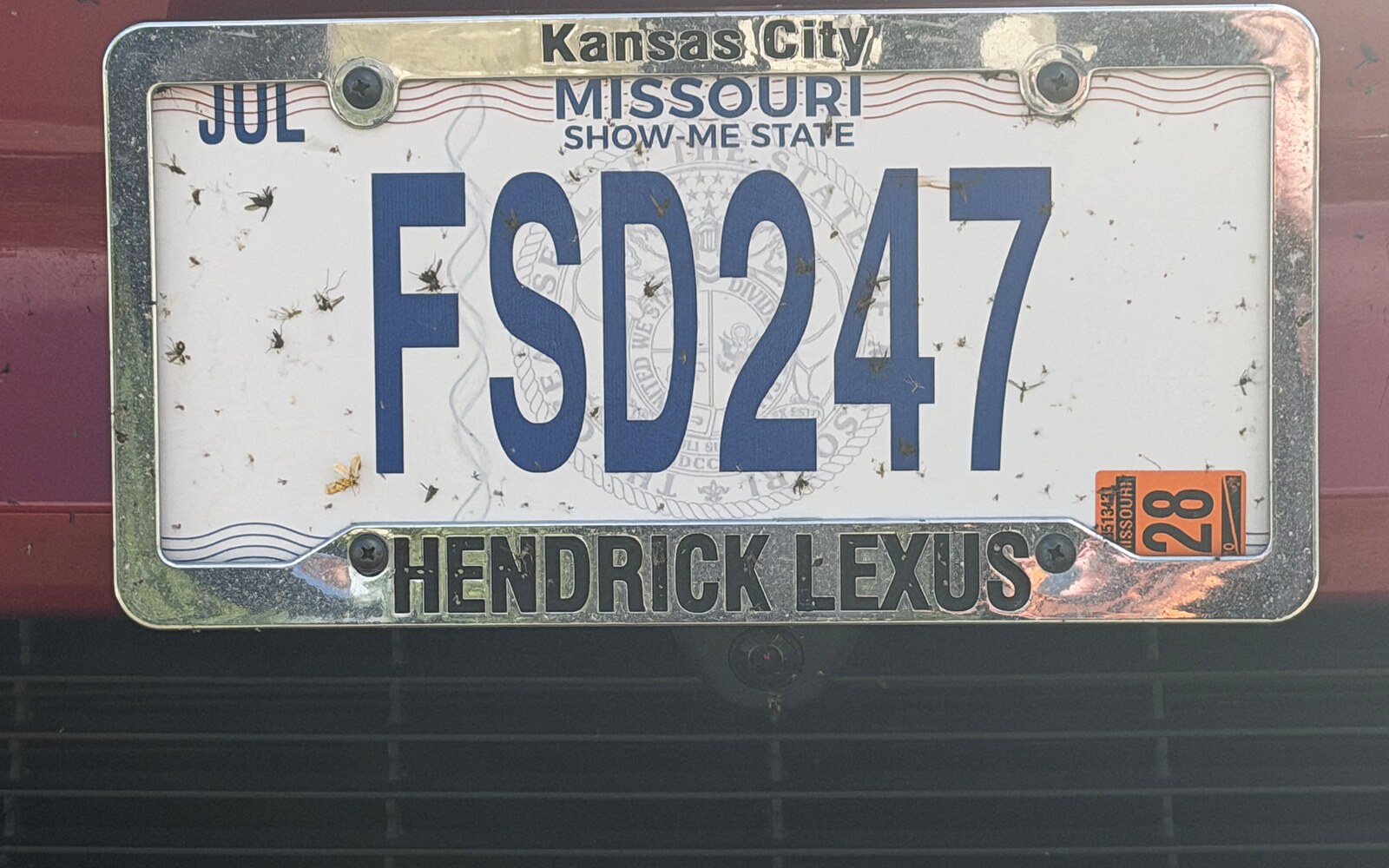
Every bug between here and the Gulf
This is the plate after the last leg. Arkansas, Alabama, Florida, and then the whole way back up through the middle of the country, and I’m fairly sure every bug…
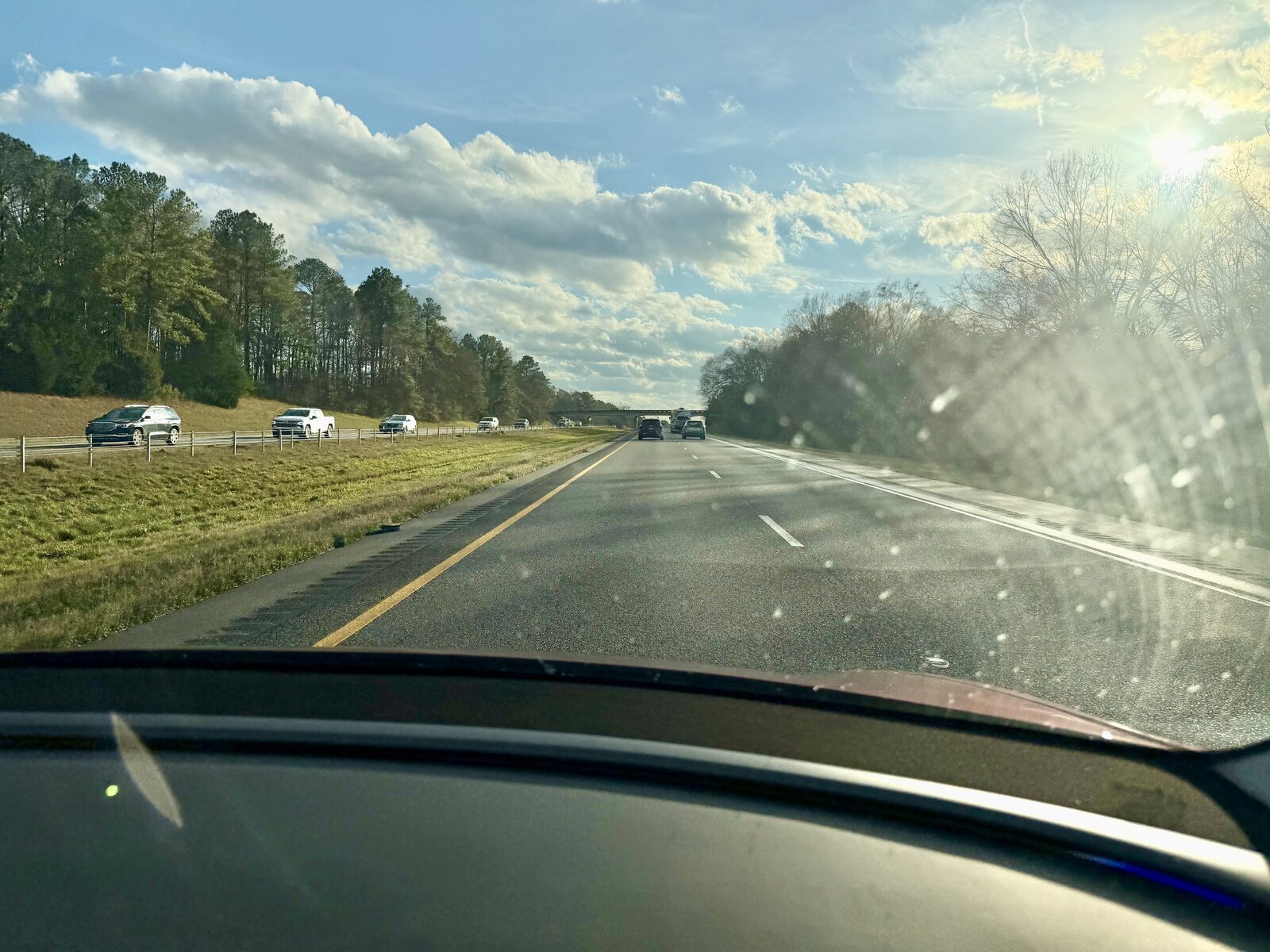
The cameras see through bugs better than I do
This windshield is what a southern interstate does to a car in the summer. Every one of those specks used to be airborne, and the front cameras live behind that…
Thinking about a Tesla? Get 3 months of FSD free.
Use my Tesla referral → Referral code: roger804133Not buying anything today? The same link books a demo drive, so you can go drive FSD yourself first.
Schedule a demo drive →Tesla gives you 3 free months of FSD and credits me, for an order or a demo drive. It costs you nothing either way. Full terms →